
MEDICAL APPLICATIONS
HEATING COMPONENTS AND CERAMIC / AIN SUBSTRATES
We supply heating components, ceramic capacitors, and equipment with complete technology, from ceramic powder to finished product. MLCC CAPACITORS – SLC CAPACITORS – THICK-FILM CIRCUITS – TECHNICAL CERAMIC SUPERCAPITATORS, multilayer ceramic capacitors, thick-film hybrid circuits, sensors, and heating elements.
CATALOG
- Ceramic heaters based on Al2O3, BeO, AlN, YTZ
- Heaters on Kapton, polymers
- Heaters on metal AISI 444, 403
- Heating elements: metal, carbon
- Substrates: Al2O3, AlN, BeO, Si3N4, YTZ, metal, glass, polymer, LV ferroelectric based
- PME conductor: Ag/Pd, Ag/Pt, Ag, Au
- BME conductor: Ni, Cu, W
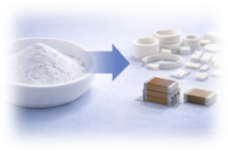
CUSTOM SOLUTIONS CAN BE studied FOR THE CUSTOMER
MEDICAL SENSORS – APPLICATIONS
Sensaggio offers MULTI RANGE sensors on the market that manage up to 8 different pressure ranges in a single product.
Sensors for medical ventilators in operating rooms
As it is often a matter of life and death, medical ventilators are carefully designed to ensure efficiency for patients. With a family of sensors designed for multiple system applications, from flow measurement to inlet, inspiratory, expiratory, and barometric pressures, we offer numerous features that significantly improve patient-ventilator synchrony and overall system performance:
- Inlet pressure
- 80 to 150 psi • Available in absolute and gauge pressure modes
- Flow
- Differential pressure of 25 cmH2O and 130 cmH2O • Available in high resolution and extreme resolution
- Inspiration
- Differential pressure of 130 cmH2O • Available in high resolution and extreme resolution
- Expiration
- Differential pressure of 25 cmH2O and 130 cmH2O • Available in high resolution and extreme resolution
- Barometry
- From 350 to 1100 mBar
Spirometry Sensors
A key component of the treatment plan for many different lung conditions, spirometry requires high-performance differential pressure sensors to accurately diagnose a patient’s lung function. Therefore, we offer several features that significantly improve the calibration, real-time accuracy, and ease of use of these mostly portable devices:
- Zero Error: 0.015 RMS
- Suitable for neonates and adult athletes
- Pressure ranges from ±250 Pa to ±40 kPa • Ultra-low noise, 19-bit effective resolution
- Selectable bandpass filter • From 25 Hz to 250 Hz
- Extremely high accuracy • Within 0.10% of FSS
Sleep Apnea Sensors
To meet the needs of those suffering from various sleep disorders, including sleep apnea, positive airway pressure devices (CPAP/BiPAP/APAP) ensure proper breathing during sleep. We offer several components that significantly improve the safety, accuracy, and functionality of these devices, while reducing overall system costs.
- Differential pressure sensor with 4 measuring ranges • Measuring ranges from ±250 Pa to ±2.5 kPa
- Relative pressure sensor with 4 measuring ranges • Measuring ranges from ±2 kPa to ±6 kPa
- 17.5-bit effective resolution with ultra-low noise
- Selectable band filter • From 25 Hz to 250 Hz
- Extremely high accuracy • Within 0.05% of full scale
Industry leading 24-bit output – Advanced filtering & lowest noise floor enables high turndown ratio- Exceptional zero stability -Support 1k/sec+ sensor update rates with 12 kHz oversampling; eliminates need for end system to oversample sensor outputs – Optional closed loop control.
MEMS – IN CONTACT WITH FLUIDS
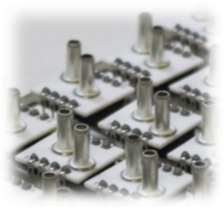
We also offer state-of-the-art piezoresistive MEMS pressure sensors with temperature compensation, and ceramic pressure sensors which can provide an analog, digital, or combined output signal.
The measured pressure range of our pressure sensors is a few millibars to a few bars. Pressure sensors can therefore be used as flow switches, that monitor the flow rate and notify a measuring device or a system that a predefined flow threshold has been reached.
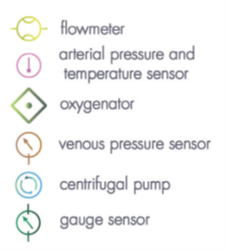
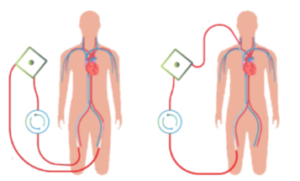
The purpose of ECMO systems is to provide a sufficiently oxygenated blood flow through the body in case that the heart or lungs of a patient are not capable to perform that.
These, state-of-the-art piezoresistive temperature-compensated MEMS pressure sensors can deliver analog, digital or combined output signal. Our pressure sensors are also capable of air temperature adaptation, which enables higher patient comfort.
Pressure Sensors for Mechanical Ventilation
We supply the following types of pressure sensors suitable for medical ventilators:
- Relative Pressure Sensors. These heavy-duty pressure sensors (or supply pressure transducers) are used to measure the pressure between a filter and a pressure regulator, starting with ambient air and oxygen inlet, and must support pressure ranges from 2 bar (30 psi) to 7 bar (100 psi).
- Low-pressure differential and bidirectional pressure sensors (or flow transducers). These are highly precise low-pressure sensors used to measure airflow and regulate oxygen concentration. The sensors must cover pressure ranges from 10 mbar (0.1 psi) to 100 mbar (1.5 psi).
- Absolute/barometric pressure sensors are used to monitor ambient/atmospheric pressure. These sensors are used to regulate breathing air based on barometric and altitude changes in the patient’s environment and must cover pressure ranges from 700 mbar (10 psi) to 1250 mbar (18 psi).
- The above-mentioned sensors are used to measure pressure:
- on the inspiratory path (attached to the patient),
- on the gas lines leading to an external humidifier,
- on the expiratory path (from the patient during respiration into the ventilator).
BIOMETRIC SENSORS
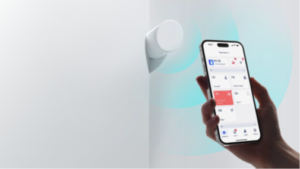
Sensaggio completes its product range with biometric sensors for remote monitoring of key vital signs (in the car, at home, and in the hospital). Vital signs can be monitored to identify emergencies and distressing situations.
Behavior can be analyzed to prevent/predict potential problems.
Presence can be tracked to enable advanced automation for comfort and safety.
Home monitoring of falls and health: 99% accuracy in fall detection, • Reliable alerts for any type of fall • Validated with over 10,000 real falls
24/7 monitoring capabilities • 6 x 6 meter coverage • No dead zones • Easy installation in less than 10 minutes • No assistance required
Thanks to a smartphone app, you can have remote check-in for maximum peace of mind.
In the car, it provides a precise seat belt reminder, automatically deactivates child airbags to earn +2 EuroNCAP points, detects intrusions/presences in the passenger compartment when the car is turned off in less than 500 ms, and monitors the driver’s health and physical condition.